
Four stages. Sixteen cognitive competencies, plus eight emotional. Published openly so it can be taught, translated, cited and built on. The framework is the vocabulary; the instrument that measures it is the product.
REAL describes what a person does, in order, to close the distance between the response they know is right and the one they actually produce. It is a process rather than a personality type: everyone can run it, and everyone runs some stages better than others. The Profile measures where the sequence breaks down — which is what makes a score actionable rather than descriptive.
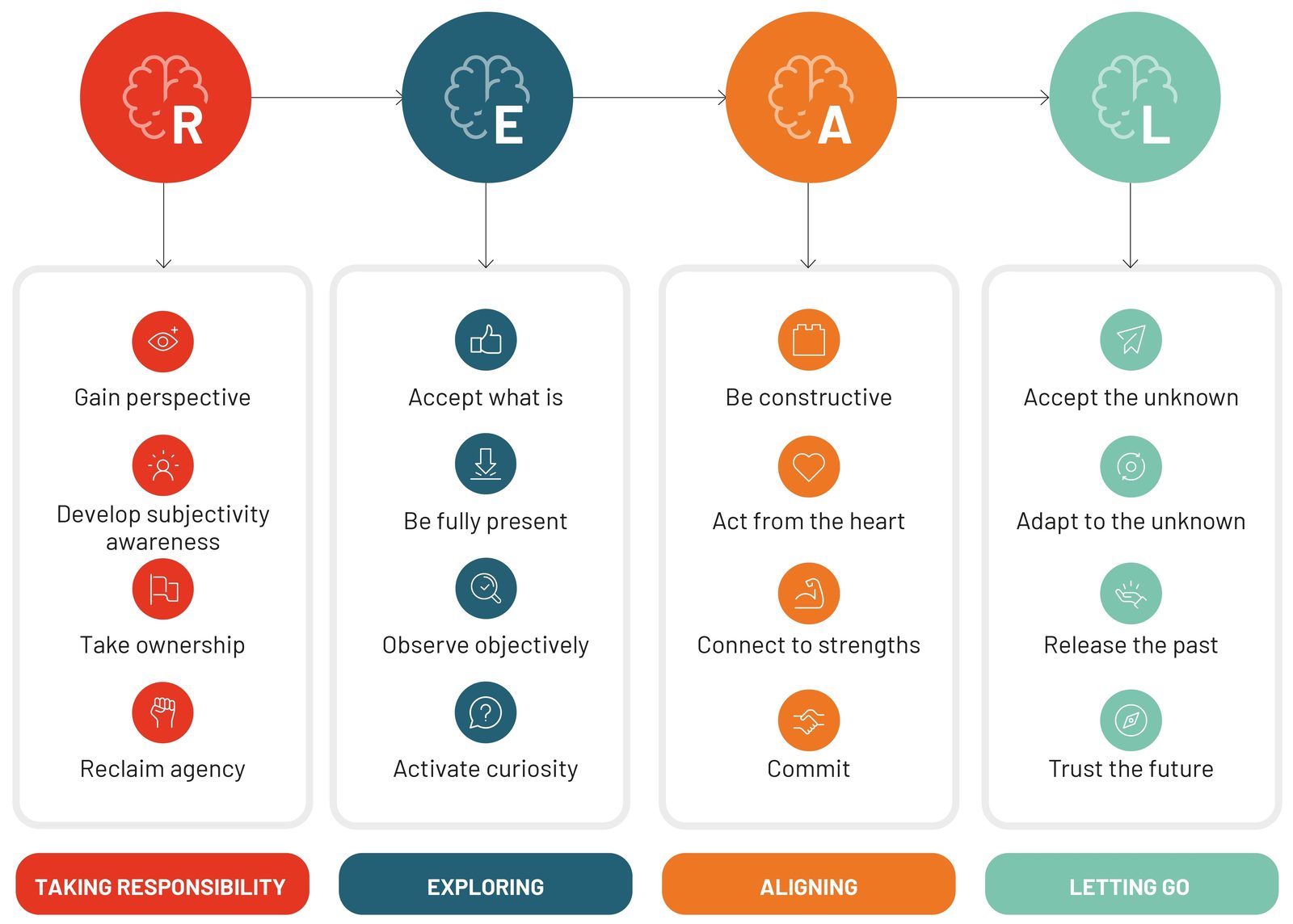
Stepping out of the reactive loop and becoming the author of the situation rather than its subject.
| Competency | Definition |
|---|---|
| Gain perspective | Step back far enough to observe the impact of the event on your thoughts, emotions and physical sensations, instead of reacting from the automatic mental mode. |
| Develop subjectivity awareness | Recognise that your experience of a situation is the product of your own interpretation, not of the situation itself. |
| Take ownership | Acknowledge how you contributed to what happened — through poor anticipation, a misjudged reaction, or inaction. |
| Reclaim agency | Move from subject to author: decide to move through the situation and build a reality closer to the outcome you want. |
Gathering information that is not distorted by certainty, assumption or the pattern-matching of the automatic brain.
| Competency | Definition |
|---|---|
| Accept what is | Read the present situation as the result of a chain of prior causes and consequences. Acceptance enables action; it is the opposite of resignation. |
| Be fully present | Reduce the flow of internal thought enough to look, listen and feel without extrinsic distraction. |
| Observe objectively | Investigate the whole situation without presupposition or judgement, to obtain undistorted information. |
| Activate curiosity | Ask good questions with genuine interest, seeking the accurate answer rather than the one the automatic mode offers first. |
Choosing a constructive intention and connecting to personal and collective resources before acting.
| Competency | Definition |
|---|---|
| Be constructive | Set the intention to build, contribute and help others grow, and to come out of the situation a better version of yourself. |
| Act from the heart | Connect with yourself and others, stay open under criticism, and create interactions where each person finds their role. |
| Connect to strengths | Draw on your own singularity and bring it to the situation, rather than being overwhelmed by it. |
| Commit | Be clear on decisions, aligned with your values, and follow through — the kind of person others can build on. |
Meeting uncertainty without defensive posture, and trusting the process enough to keep moving.
| Competency | Definition |
|---|---|
| Accept the unknown | Consciously switch from reactive to adaptive mode and treat the unknown as a source of opportunity rather than threat. |
| Adapt to the unknown | Keep moving forward in small steps, working around obstacles instead of spending energy resisting the current. |
| Release the past | Free the energy consumed by resentment; forgiveness releases the past and gratitude strengthens the bond with others. |
| Trust the future | The highest level of letting go: recognising that every situation teaches something, and no longer being a prisoner of chance. |
The sixteen cognitive competencies describe how a leader thinks their way out of automatic mode. Eight further competencies measure what happens emotionally while they do it — divided between collecting emotional information and regulating it.
The quality of awareness of what is being experienced inside, and of what is happening in the other person.

Being able to observe yourself — your thoughts, your emotions and your physical sensations.

Not reacting defensively when criticised, but seeking to understand the reasons behind the criticism in order to calmly accept it, decline it, or explore it further.

Listening deeply: being fully present, perceiving what is happening both inside yourself and outside, and sensing what the other person is experiencing.

Putting yourself in the other person’s place and taking account of what they feel, without judgement or preconception, in order to support them better.
The quality of the actions taken to regulate an emotional state once it has been clearly identified.

Staying calm in the face of pressure and adversity, without becoming defensive or slipping into resistance.

Remaining in a constructive frame of mind and holding to the aim of producing positive solutions in any situation.

Staying aligned with your own deeply held convictions and values, and asserting them without fear of what others think or say.

Staying calm and serene in any situation, and creating the conditions that generate wellbeing for yourself and for others.
These eight, together with the sixteen cognitive competencies, are the 24 competencies the report scores and synthesises across the two components of the R.E.A.L. Adaptive Response Index™: collect — the twelve competencies used to gather information without distorting it — and regulate, the twelve used to decide well and return to a settled state. Two families of competencies rather than two moments in time.
Two further dimensions are measured alongside them. Behavioural adaptivity is scored against each of the four DISC® styles — the capacity to avoid the trap behaviours that style falls into under pressure. Frustration adaptivity is measured across six facets. All of it comes from a single 48-item, 15-minute assessment; competitors typically need two or three separate instruments to cover the same ground.
The framework is supported by six commercially packaged e-learning programmes, around sixty video lessons in total, already sold at retail in French. Certified practitioners resell them to their own clients; a distribution partner can localise and resell the whole catalogue.
| Module | Commercial programme | List price | Content |
|---|---|---|---|
| Self Mastery | Executive Stress Mastery | €230 | Stress response, the four decision centres of the brain, emotional regulation, and applied behavioural tools. The recommended companion programme to the REAL Profile. |
| Communication | Executive Communication Mastery | €220 | The communication tunnel, preparing a conversation, active listening, questioning, consensual and adaptive communication, DESC, recognition signs. |
| Conflict | Executive Conflict Mastery | €190 | Positive intent, relational stress management, herd positioning, handling bad faith, the Ofman quadrant and double quadrant. |
| Delegation | Executive Delegation Mastery | €220 | Collaborator maturity, competence and engagement assessment, the four leadership styles, the full delegation process, delegating with DISC. |
| Management | Executive Management Mastery | €170 | Decision-making, the constellation of choice, trust, beliefs and drivers, time management, the Eisenhower matrix, visibility. |
| Neurosystemics | Executive Governance Mastery | €260 | Organisational purpose, defining roles, circles, leader roles and needs, encoding, client–supplier loops, dynamic tensions, governance and steering meetings. |
French retail list prices, sold individually or as a complete pack at €950. For the REAL Profile specifically, Self Mastery is the recommended companion programme. All content is subtitled and translatable.
Above these six sits the Neuro-Management R.E.A.L. certification — 55 hours, 38 ICF CCE units, €3,480 — which trains a coach to work at organisational level and to run the whole system: the profile, the workshops and the e-learning catalogue. It is where the framework stops being a set of ideas and becomes a professional practice. See the certification →